Thursday, March 7, 2013
Philippines Mission Trip
Hey guys!
Unfortunately, I don't have a craft to share with you today, but I do have some news!
This summer I will be going on a missions trip with my church to the Philippines! There we will be working at the Young Life Center in Cebu where we will be serving the people there by doing some construction work!
To get me there, however, I'm going to need your help and support!
Here's how you can help:
1) Prayer- Please keep my team in prayer before, during and after our trip! That we'd be able to raise enough money, stay safe while in the Philippines, serve with our whole hearts, and then have a smooth transition coming back.
2) Financially- The trip cost a lot of money ($2,600 is a lot for a jobless teenager!) and I could really use your support! By donating here you can get me one step closer to my goal! It doesn't need to be a lot- any amount will help more than you'll ever know!
Thank you so much for reading this, and hopefully I'll have a craft up here for you guys soon! I've got a project I'm working on right now, but it's taking longer than I though it would.
God bless and thanks for considering supporting me on this new and exciting adventure!
-Micayla
Thursday, February 28, 2013
Confetti Dessert Platter
Tutorial
Hey guys!
So today's tutorial is inspired by two pins that I found on Pinterest (like every other tutorial.. haha!). The first pin is making a dessert platter out of a plate and a cup, and the second is an Anthropologie knockoff of their confetti tumblers. I didn't mean to put the two crafts together, but it ended up working really well together! I love this one- it might even be my favorite craft so far!
Here are the supplies you'll need:
- A plate and a glass (My glass was a margarita glass from Goodwill.)
- Super glue or "Cement"
- Acrylic paint
- All purpose sealer or Mod Podge
- Paint brushes (At least one small brush and one large one.)
Step 1: After washing the two dishes, apply the super glue or cement to the rim of the glass.
Step 2: Press the glass onto the center of the bottom of the plate.
Make sure that the glass is in the center of the plate. If it's off center you can adjust it, but then some of the glue is on the inside and isn't touched by outside air, and that makes it not dry clear.
Now this was my project after 12 hours.
Not sure if you can see clearly, but all the glue on the outside of the rim of the glass dried clear, but the glue on the inside of the glass isn't dried very well.
I figured that it wasn't going to dry anytime soon and I'm a bit of an impatient person with somethings, so I decided to find an alternative method to hide the undried glue.
At Michael's I bought five shades of blue acrylic paint and multi-purpose sealer. It only ended up being $7 with a 50% off coupon for one item! The acrylic paint is only $0.69.
Step 3: Using the small paint brush, alternate paint colors and paint dots all over the plate.
This is my plate before the seal.
Step 4: Using the large paint brush, apply the all purpose sealer or Mod Podge over the whole plate.
Let it dry, and then CAREFULLY wash the dish so it can be used.
Here's the final product with the delicious lemon bars I made!
So, that's the tutorial! Leave a comment below if you have any questions about the craft or if you want to share your own version of the craft.
Happy crafting!
-Micayla
Tuesday, February 26, 2013
Knitted Skinny Headband with Bow
Tutorial
![]() |
| Craft Inspiration |
Hey guys!
So this tutorial is inspired by yet another pin that I found on Pinterest. I've done knitted headbands before, like my Cinched Headband, and I've done Knitted Bows before, but this one is a combination of the two.
This is a skinnier headband than I've done before. The band is actually about half the width of the bow, but I like it a lot!
Here are the supplies you'll need:
- Yarn
- Knitting needles
- Scissors
- Embroidery needle
I absolutely fell in love with the color of this yarn when I saw it in Michaels! It looks darker in the picture than it actually is.
Anyway...
Step 1: Cast on 10 stitches
Step 2: Continue knitting until you have a band that fits around your head.
Cast off.
Step 3: Using the embroidery needle, sew together the two ends of the headband, making it a full circle.
Step 4: To make the thicker bow, cast on 20 stitches.
Then follow my Knitted Bow Tutorial for instructions on the bow portion of the headband.
Step 5: You should then collect the following items: A completed bow, a plain headband and some leftover string.
Use the leftover string to tie the bow and the headband together. I would recommend putting the cinched part of the bow over the sewn together part of the headband in order to disguise the sewing job.
Once you've tied the knot, wrap the leftover string around the headband and cinched bow several times to keep the two together and to cinch the headband a little as well.
You are then left with your final product!
If you have any questions about this tutorial or if you would like to share your own versions of this craft, please post below in the comments.
Happy crafting!
-Micayla
Sunday, February 17, 2013
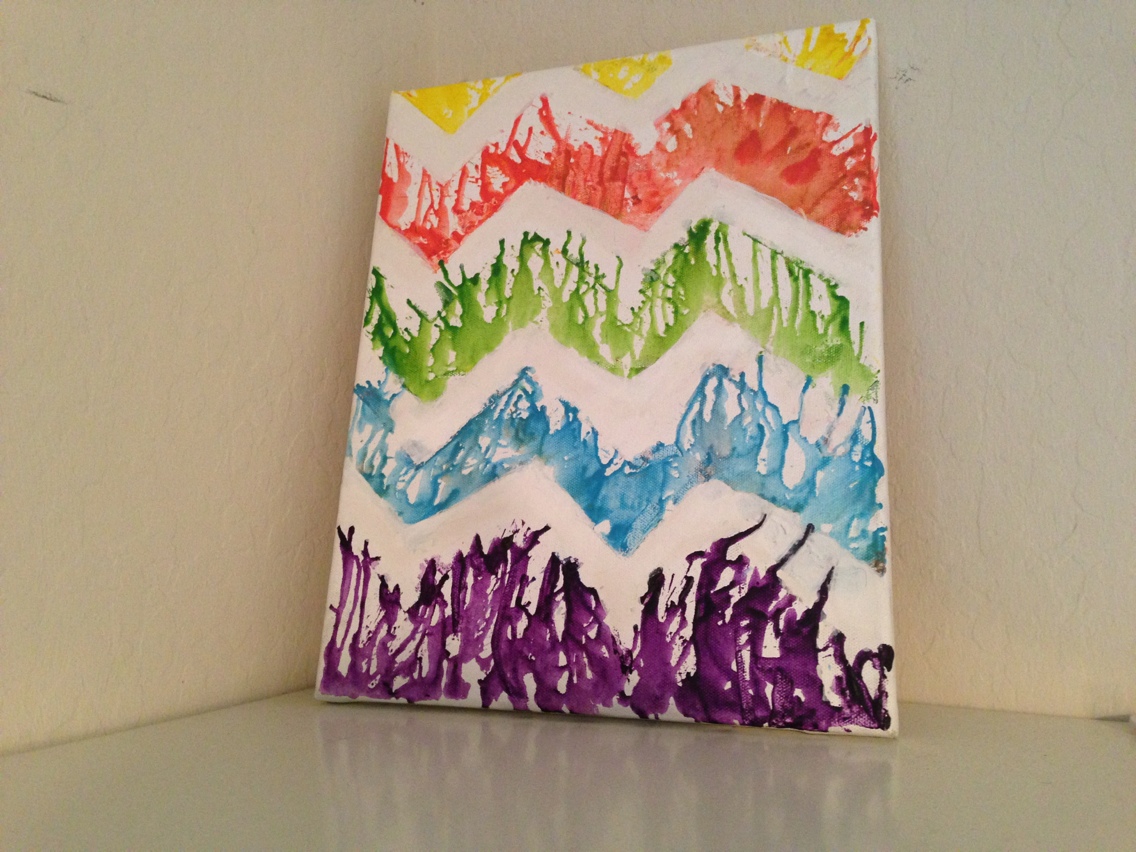
Chevron Melting Crayons
Tutorial
Hey guys!
First of all, I just want to say THANK YOU SO MUCH for helping me hit over 1,000 page views! It's a huge milestone for me and it really meant a lot. So keep coming back so I can hit 2,000!
![]() |
| Craft Inspiration |
I decided (partially because of my smaller canvas) to make my pattern thicker and use less colors.
I read the blog that did the tutorial for this project but there weren't step by step instructions and also, she used the 'crayons-in-the-hot-glue-gun' method while I chose the hairdryer method.
I've never used the hot glue gun for anything more than gluing things down but I imagine that putting crayons through the gun leaves it a little messy, so I chose a different (and hopefully neater) path.

Here are the supplies you'll need:
- Canvas
- Crayons (Only about 5 or 6)
- Scissors
- Tape (I wouldn't recommend duct tape)
- Hairdryer
- Ruler
- Newspaper
- White paint (For covering mistakes. Optional.)
Step 1: Choose your colors.
I picked out 6 colors but only ended up needing to use 5.
How many colors you end up using all depends on the thickness of your chevron pattern and the length of your canvas.
You can use the ruler to measure out how thick you want each chevron to be and then see how many crayons you'll need.
Step 2: Peel the crayons.
Step 3: Make the tape into a zig zag formations, and then make an exact replica.
Now, I used duct tape, but it wasn't the best choice of tape. It stuck to the canvas, but a little too well once I turned on the hairdryer. There were bits of residue from the duct tape once I tore it off, but luckily it got covered by the dripping crayons.
Step 4: Use the hairdryer to melt the crayons.
What I realized works best is holding the hairdryer parallel to the canvas so that the hot air blows down, parallel to the canvas. If you just blow the hot hair straight on (perpendicular) to the crayon, then it sprays out crazy and doesn't drip nicely.
The problem with the hairdryer method is that the melted crayons are really unpredictable. They sometimes spray all over the place and can be super frustrating, but eventually you'll get the technique down.
If not, don't worry, I have a cheating solution that I used.
Here's a close up of the crayon/hairdryer.
What I would recommend doing to make the chevron pattern look better, is tracing the outline of the tape with the half melted crayon. That way there is a bold chevron pattern, and then crayons melting down.
I felt like that little step would make my project look better, but it's up to the individual artist.
**Note: Save the leftover crayons- you may need them later.
Step 5: Move the tape up.
Now here is when it starts to get a little messy and frustrating.
It's at this step where you realize that it doesn't look as good as you thought or where the tape sticks or where you see the crayons spattering in unwanted areas but IT'S OKAY.
Like I said earlier, I found a way to (kinda) fix the mistakes.
Step 6: Repeat the process for each chevron.
Now I realized halfway through that you need to cover the already melted crayons in newspaper or something because the other colors will sometimes mix together.
What I did was cut a big piece of newspaper and tape it onto the canvas to hide the finished part of the project. But in order to let the top parts drip correctly, you need the full "V" so I taped the big square at the trough (or lowest point) of each zig zag and then took smaller pieces and taped them on the peaks (or highest parts) in order to cover everything but also leave the full shape.
This is why I had you make two of the same chevron patters- to stop the crayons from dripping down.
Okay, this WAS my final product before I cheated and fixed my project up a little.
To fix my mistakes I first took out a butter knife and tried to chip away at some of the dried crayons to make it look better. Then, after not much was changing, I took out some white paint and began painting over my mistakes.
This worked surprisingly well, just make sure to paint a layer...then wait...and then paint another layer. You definitely need multiple layers and if you're impatient like me, you need to remind yourself to wait and let the first coat dry before painting on another coat.
Here's my final product (again). You can play around with which side is up, and which side is down. I ended up liking my project better when it was upside down.
Well, if you try out this project, let me know in the comments how it goes or if you have any questions!
Happy crafting,
-Micayla
Friday, February 1, 2013
Knitted Chunky Scarf
Tutorial
Hey guys! So I found this pin on Pinterest of how to knit a scarf on your arm and I thought it was so cute and seemed easy to do!
I tried to follow the video featured on the blog linked to the pin, but I didn't find her video to be very helpful when it came to technique, so I searched for a better video and found this one.
I however didn't have extremely chunky yarn so I had to modify the tutorial.
Here's what you'll need:
- Yarn
- Scissors
- Arms
So if your yarn is chunky, you can cast on 5 or so stitches like the video does, but if you're like me and only have thin yarn on hand, I casted on about 12-15 stitches to make it as wide as a normal scarf.
Step 1) Cast on (see video)
Step 2) Knit! (see video)
This is what it begins to look like.
Because the yarn was so thin and I was making an infinity scarf, I made it long enough to wrap around my neck three times to make it look more bulky.
If your yarn is thicker, you can knit a shorter scarf.
Step 3) Cast off (see video)
Step 4) To tie the ends together and make it an infinity scarf, I literally just tied four knots along the ends. Once I put on the scarf I make sure that the knots are in the back so no one can see. If you want to connect the scarf the right way, you can see the video below starting at around 9:13.
I plan on doing another one of these and doing it with thicker yarn, so hopefully it'll turn out even better!
Happy crafting,
-Micayla
Happy crafting,
-Micayla
Wednesday, January 30, 2013
Hex Nut Bracelet
Tutorial
So one of my first pins on Pinterest was some of those hex nut crafts where you braid the hex nuts into the fabric and then wear it as a bracelet or a necklace. On a random trip to OSH I bought some hex nuts but never got around to making it back then, so I decided to finish it this afternoon!
I was searching for a tutorial online because braiding the hex nuts into a bracelet proved harder than I though it'd be, but I couldn't find any so I made my own variation of the craft that's MUCH easier.

Here's the supplies you'll need:
- Hex nuts (Quantity depends on what you want to make. I made a bracelet and used 14.)
- Ribbon or yarn - a LOT of it. I used about 10 feet of yarn cut up into three sections.
- Scissors
Step 2: Tie a knot connecting the three strands of ribbon or yarn. I had to tie my yarn 2-3 times, putting each knot over the last, to make sure that the hex nut wouldn't slide over it and my ribbon only once.
Step 3: Slide on a hex nut.
Step 4: Tie 2-3 knots on top of each other for yarn or only once for ribbon to hold hex nut in place.
Step 5: Repeat this step until all of your hex nuts are tied securely onto the ribbon or yarn.
Step 6: Tie ends together to make bracelet (or necklace).
And you're finished!
Hope you guys enjoyed this tutorial! It's a lot easier than the braided hex nut crafts but still gives the same effect.
Happy crafting,
-Micayla
Thursday, January 24, 2013
Knitted Quilt Pillow
Tutorial
So, like any high school senior, college is the number one thing on my mind currently. But since I'm obsessed with room makeovers and Pinterest, my future dorm room is also a often thought about topic. When planning the color scheme of my dorm room, coral immediately came to mind, but I had no idea what would go with it... until I pulled out my yarn.
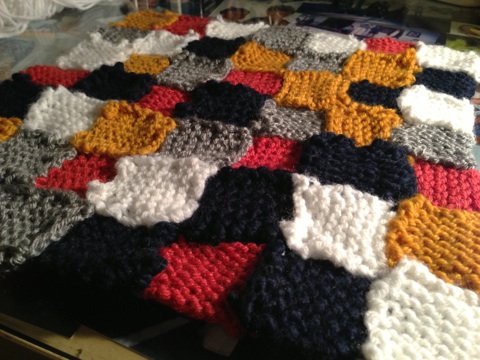
I found that I liked the color combination of coral, white, grey, yellow and navy blue, so I decided to make a throw pillow that will hopefully be sitting on my new bed next year!
![]() |
| Craft Inspiration |
I got my inspiration from this pin on Pinterest, and decided to model my second pillow after it!
Here are the supplies you'll need:
- Yarn (colors of your choosing, however I would recommend you to also have white yarn for the back.
- Knitting needles
- Scissors
- Embroidery needle
- Pillow stuffing (once again, I just cut open an ugly pillow I got for cheap)

Step 1: Knit squares- lots of them. For this I casted on 8 stitches for each one and then knitted until it formed a square. For my project I made 9 squares in each color and then knitted a few extras to make the full rectangle but you can vary that based on the size of the pillow you want to make.
Step 2: Lay out all of your squares in your final formation.
Step 3: Use the embroidery needle to sew all of the squares together. I found it easiest to just start in one corner and add on from there. In order to make the squares come together well and not look too messy, overlap one square over the other and use the same colored yarn as the top square to sew them together. That way you can't see the sewing because the sewing yarn and the knitted yarn are the same color.
Step 4: Knit the back. I would do this step after the squares because then you can see exactly how large your pillow will be once the squares are all sewed together. For my back, I casted on 60 stitches and then kept knitting and measuring and knitting and then measuring until the back of the pillow cover the front. Step 5: Sew together the front and back using the embroidery needle. I found this fancy new way to sew together two knitted things and making it look nicer! You can check out the tutorial here.
Step 6: Add stuffing.
Step 7: Finish up by sewing together together the final hole and...
You're finished with your pillow!
Hope you enjoyed this tutorial! Let me know in the comments below how yours went or if you have any questions.
Happy crafting!
-Micayla
Subscribe to:
Posts (Atom)